VLESS + REALITY + XTLS Vision Explained Like You're Human
"VLESS + REALITY + XTLS Vision" sounds less like a VPN protocol and more like a sci fi starship. Or a very intense yoga retreat. Either way, it is one of the most effective tools in the world right now for getting past firewalls that block VPNs, and it is a big part of how OurVPNs Stealth mode works.
The usual explanations are written by engineers, for engineers. This one is written for the rest of us. By the end you will know what each of the three pieces does, why they work so well together, what that long scary vless:// link actually means, and when this setup is (and isn't) the right choice.
The quick answer
VLESS + REALITY + XTLS Vision is a stealth connection made of three layers:
VLESS is the delivery service. It carries your traffic and checks your ID, and that's it. It is deliberately tiny.
REALITY is the disguise. It makes your connection look like a normal visit to a real, popular website, down to the handshake.
XTLS Vision is the body language. It smooths out the telltale traffic patterns that would otherwise give away that there's a tunnel inside.
Together, they make a connection that looks like ordinary HTTPS browsing to a firewall, even one that actively investigates. That is why it holds up in places like China and Russia, where regular VPNs like WireGuard and OpenVPN get blocked. For the big picture first, see our stealth VPN guide.
Why regular VPNs need a disguise in the first place
Imagine trying to walk into a building wearing a giant neon sign that says "I AM A VPN." That's roughly what WireGuard and OpenVPN look like to a modern firewall. They are secure, nobody can read what you send, but they look exactly like what they are.
Countries that block VPNs use deep packet inspection, which means the firewall looks at the shape of your traffic: how the conversation starts, how big the pieces are, and where it's going. It doesn't need to read your messages to know you're using a VPN. Our OpenVPN vs WireGuard guide covers why those two struggle here.
So the goal of VLESS + REALITY + XTLS Vision isn't just "encrypt the traffic." It's "make the traffic look boring." Let's take the three pieces one at a time.
Piece 1: VLESS, the delivery service
VLESS is a proxy protocol from the open source Xray project. The name roughly means "VMess, but less," because it's a slimmed down version of an older protocol called VMess.
Here's what VLESS does:
Checks your ID. Every user has a long unique ID called a UUID, something like
a3f1c2.... The server checks it on every connection. Right ID, you're in.Says where your traffic should go. It carries the address of whatever website or app you're trying to reach.
Carries the data. That's about it.
Here's what VLESS deliberately does not do: encrypt anything by itself. That sounds alarming until you realize it's the whole point. Older tools like VMess wrapped traffic in their own homemade encryption, which created its own recognizable pattern and wasted effort. VLESS leaves the encryption to a proper outer layer (in our case, REALITY, which uses the same modern TLS 1.3 encryption your bank's website uses). The official Xray documentation describes VLESS as a "stateless lightweight transport protocol," which is engineer for "small, fast and doesn't need anything fancy."
Think of VLESS as a courier with a clipboard. Checks your name, takes your package, delivers it. No small talk.
Piece 2: REALITY, the disguise
This is the clever part.
Normally, when your phone connects to a website over HTTPS, the two sides do a quick introduction called a TLS handshake. The website shows its ID card (a certificate), your phone checks it, and they agree on how to encrypt things. Firewalls watch these handshakes closely, because a handshake with a strange, self made or rarely seen certificate is a big red flag.
Older stealth setups had a problem here. To look like HTTPS, they needed their own domain and certificate. That domain could be noticed, investigated and blocked, and the server's handshake had its own small quirks that could be fingerprinted.
REALITY skips all of that by borrowing a real website's identity. When your device connects, the handshake looks like you're visiting a genuine, popular site that already exists, say, a big tech company's homepage. The firewall sees a perfectly normal TLS 1.3 conversation with a well known website. According to the REALITY project, it removes the detectable TLS fingerprint on the server side while keeping strong, modern security.
And here's the part that makes it really hard to catch:
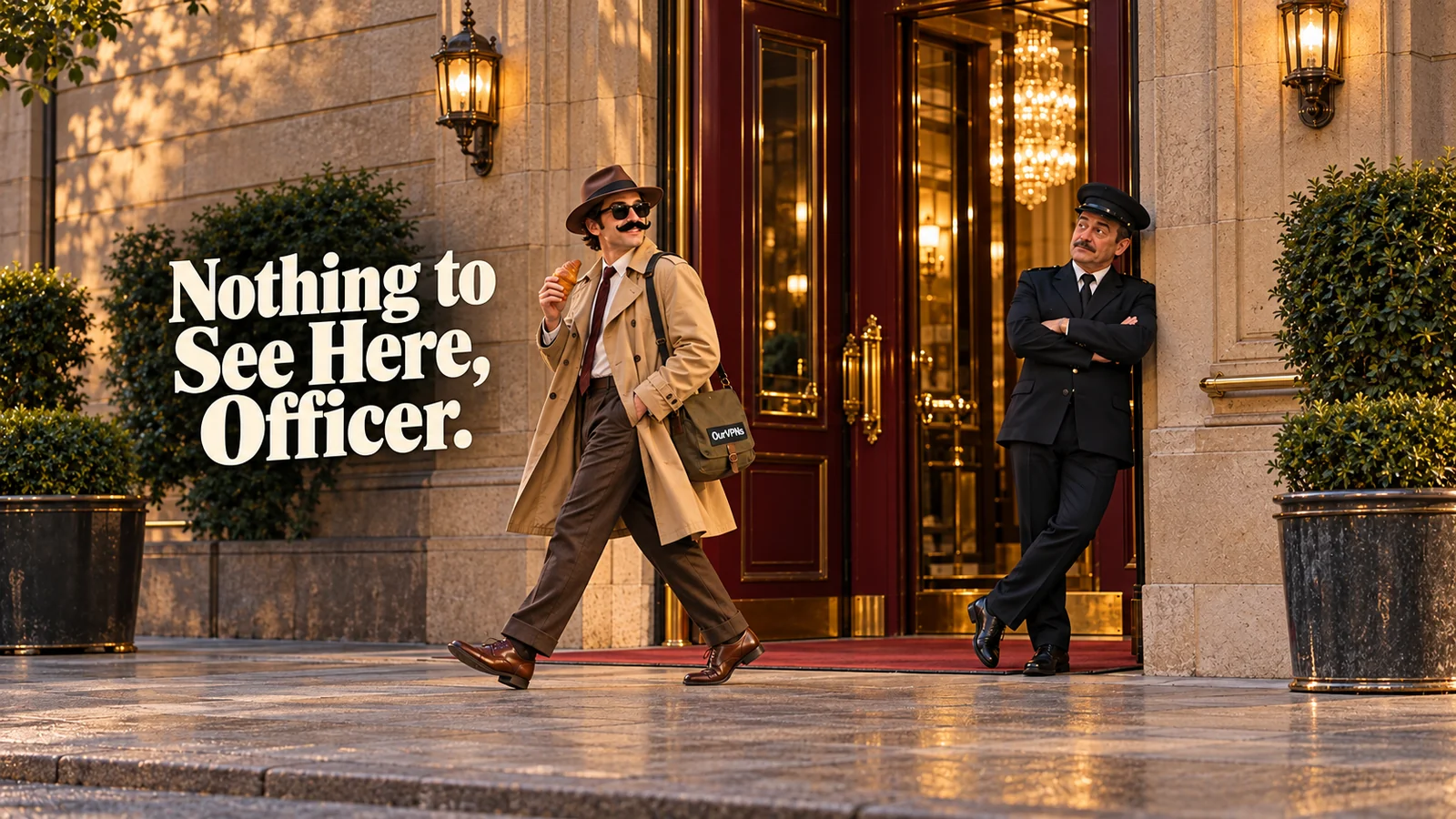
The bouncer trick. Suppose a suspicious firewall connects to the server itself to check what it is. This is called active probing, and China's Great Firewall is famous for it. A REALITY server looks at the visitor. If it's an approved user with the right secret key, they get the tunnel. If it's anyone else, including a curious firewall, the server quietly passes them through to the real website. So the investigator gets... the real website. A real certificate. A real homepage. Nothing to see here, officer.
It's like a speakeasy where the doorman, if you don't know the password, walks you to an actual bakery and hands you a croissant.
Wait, isn't that the website's identity?
Fair question. REALITY doesn't break into the real website or steal its certificate. Your device and the server share a secret key, and they use it to recognize each other inside what looks like a normal handshake with that site. The real website is never involved in your traffic. It just provides the "look" of the conversation, and the landing spot for anyone who isn't on the list.
Piece 3: XTLS Vision, the body language
So now you have a courier (VLESS) wearing a perfect disguise (REALITY). Surely that's enough?
Not quite. Here's the sneaky problem researchers found. When you browse through a tunnel, you're usually visiting HTTPS websites inside that tunnel. So you have a TLS conversation inside another TLS conversation. That creates a recognizable rhythm: a particular burst of packets with particular sizes at the very start, when the inner website does its own handshake. A 2024 USENIX Security paper showed that firewalls can fingerprint many obfuscated proxies using exactly this "TLS inside TLS" pattern.
It's like wearing the perfect disguise but walking with a very distinctive limp.
XTLS Vision fixes the walk. It does two things:
Pads the giveaway moments. It adds padding to the early packets so the inner handshake doesn't show up as that telltale burst of sizes and timing.
Stops double wrapping. Once the inner website traffic is already encrypted by its own TLS, Vision avoids encrypting it a second time for no reason. That saves processing power, which means better speed and battery life, especially on phones and routers.
In your settings, Vision shows up as flow=xtls-rprx-vision. The REALITY developers recommend pairing REALITY with the Vision flow, and that's exactly the combination OurVPNs uses.
Putting it all together
Here's what happens when you tap connect, in human terms:
Your device starts a handshake that looks exactly like a normal visit to a popular website, complete with a Chrome style browser fingerprint.
The firewall watches and sees boring, everyday HTTPS. It shrugs.
The server recognizes your secret key inside that handshake and opens the tunnel. Anyone without the key would have been sent to the real website instead.
VLESS checks your ID and carries your traffic.
XTLS Vision smooths out the traffic pattern so it doesn't look like a tunnel within a tunnel.
With OurVPNs, your traffic then exits through a real U.S. home internet connection, so the website at the end sees a normal residential IP, not a datacenter.
That last step is the part most stealth setups skip. Getting past the firewall is great. Landing somewhere your bank trusts is better. Our guide on what a residential VPN is explains why that matters.
That long vless:// link, decoded
If you've ever been handed a VLESS link, it looks something like this (made up values):
vless://a3f1c2d4-....@203.0.113.10:443?encryption=none&flow=xtls-rprx-vision&security=reality&sni=www.example.com&fp=chrome&pbk=Xy7...&sid=6ba8&type=tcp#OurVPNs-Stealth
Here's what each piece means, in plain English:
a3f1c2d4-.... is your UUID, basically your password. Never share it.
203.0.113.10:443 is the server address and port. 443 is the normal HTTPS port, which is part of the disguise.
encryption=none looks scary but is normal for VLESS. Encryption comes from the REALITY layer, not from VLESS itself.
flow=xtls-rprx-vision turns on XTLS Vision.
security=reality turns on REALITY.
sni=www.example.com is the real website your connection is dressed up as.
fp=chrome tells your app to make its handshake look like the Chrome browser.
pbk=... is the server's public key, used to recognize the real server.
sid=... is a short ID, an extra little secret that identifies you to the server.
type=tcp means the connection runs over TCP.
#OurVPNs-Stealth is just a nickname shown in your app.
You never have to type any of this. Apps like v2rayNG and Hiddify import the whole thing from one copy or one QR scan. Our v2rayNG guide walks through it step by step on Android.
How it compares to the other options
You'll see these names around, so here's the 30 second version:
WireGuard and OpenVPN: excellent and secure, but easy to recognize. Great at home, often blocked in censored countries. AmneziaWG is a WireGuard fork built to fix exactly that, as our guide to what AmneziaWG is explains.
VMess: VLESS's older sibling. Heavier, with its own encryption and time checks, and easier to spot.
Trojan: also disguises itself as HTTPS, but needs its own domain and certificate, which can be found and blocked.
Shadowsocks: makes traffic look like random noise. That worked for years, until firewalls learned that pure randomness is itself suspicious.
Hysteria2: a different stealth approach that runs over UDP and looks like HTTP/3. Usually faster on bad networks, but UDP gets throttled in some places. That's why OurVPNs offers it alongside VLESS + REALITY.
When to use VLESS + REALITY (and when not to)
Use it when:
you're in a country that blocks VPNs, like China, Russia, Iran, Turkey or the UAE
your VPN connects and then drops after a few minutes, which often means a firewall noticed it
a hotel, office or school network blocks VPNs
your network throttles or blocks UDP, which knocks out Hysteria2 and WireGuard
You probably don't need it when:
you're at home on normal internet. WireGuard is simpler and a bit faster.
you only need privacy on public Wi-Fi in a country with no VPN blocking
Our guide to countries where VPNs are banned or restricted shows where stealth protocols matter most.
What it doesn't do
Honesty corner, because nobody likes surprises abroad:
It hides your VPN from the network, not from websites. The site you visit sees your exit IP. With OurVPNs that's a U.S. residential connection, which helps a lot, but sites can still use other signals. More in why websites still detect a residential VPN sometimes.
It isn't magic forever. Censors study these tools, and the Xray developers keep updating them. That's normal, and it's why we keep testing.
It can't beat a full internet shutdown. If the connection is switched off entirely, there's nothing to disguise.
It doesn't change local law. Check the rules where you are.
Where OurVPNs fits
OurVPNs Stealth mode includes VLESS + REALITY + XTLS Vision, plus Hysteria2 as a second option, so you can switch in two taps when one network gets difficult. As of October 2026 we have tested Stealth working from China, the UAE, Turkey and Russia.
It's included on every plan, it works on our routers, and your traffic lands on a dedicated U.S. residential IP on real home broadband. Plans are $35 a month or $350 a year, and real humans help you set it up by email, phone or Telegram, 24/7.
Quick answers
What is VLESS? A lightweight proxy protocol from the Xray project. It identifies you with a UUID and carries your traffic, and leaves encryption to an outer layer like REALITY.
Is VLESS encrypted? VLESS itself doesn't encrypt. When paired with REALITY, your traffic is protected by TLS 1.3, the same encryption used by banking websites.
How does VLESS REALITY work? It disguises your connection as a normal visit to a real, popular website. Approved users get the tunnel. Anyone else, including a probing firewall, gets passed to the real website.
What is XTLS Vision? A setting (flow=xtls-rprx-vision) that hides the "tunnel inside a tunnel" traffic pattern and avoids encrypting already encrypted traffic twice.
Is VLESS better than VMess? For getting past modern firewalls, generally yes. It's lighter, faster and has fewer recognizable quirks.
Which apps support VLESS + REALITY? v2rayNG and NekoBox on Android, V2Box and Streisand on iPhone, and Hiddify on Android, iPhone, Windows and Mac. We compare the iPhone ones in our guide to the best VLESS apps for iPhone.
Is VLESS REALITY undetectable? Nothing is undetectable forever. It's one of the hardest setups to detect today, which is why we pair it with Hysteria2 and keep testing.
The short version
VLESS is the courier. REALITY is the disguise, borrowed from a real website, with a bouncer who sends strangers to the real thing. XTLS Vision fixes the walk so nobody spots the tunnel inside. Put together, your connection looks like boring HTTPS, which is exactly what you want when a firewall is looking for VPNs. With OurVPNs, it then lands on a real U.S. home internet connection. Want to try it? Start your free trial and set it up before your next trip.