Moving Abroad Checklist for Americans: What to Do and When
Deciding to move abroad takes about five minutes and one very good vacation. Actually moving takes months of paperwork, phone calls, and discovering that your bank has opinions about where you live.
This is the checklist we wish every American got before they left. It's in the order you'll need it, it covers the boring essentials, and it includes the digital stuff almost every other moving abroad checklist skips: the phone number your bank texts, the logins that start failing, and the TV that suddenly isn't available in your region.
The short version
If you only read one section, make it this one:
Make sure your passport has well over six months left on it.
Sort out your visa or residency path, and collect the documents it needs.
Make a plan for US taxes. You still file, wherever you live.
Keep your US phone number, and set up backup ways to get verification codes. Our guide to the best international phone plans covers the cheapest ways to do it.
Set up banking that works abroad: two banks, cards without foreign fees, and a steady way to log in.
Keep a US mailing address.
Set up your US internet connection before you leave, so your apps don't panic on day one.
Enroll in the State Department's traveler program so the embassy can reach you.
Now the full version.
3 to 6 months before you move
Passport and documents
Check your passport's expiration date. Many countries want at least six months of validity left when you enter, and residency applications often want more. Renewing from abroad is doable but slower, so if you're anywhere close, renew now.
Gather official documents. Birth certificates, marriage certificates, divorce decrees, diplomas and background checks. Residency applications often require certified copies with an apostille, which takes weeks to get, so start early.
Make digital copies of everything and store them somewhere you can reach from any device.
Visa and residency
Tourist entry usually isn't a legal way to live somewhere long term, so pick your real path early. The common ones for Americans:
Retirement visas for people with a steady pension. Costa Rica's Pensionado and Panama's Pensionado are two of the best known.
Income or investment based residency for people with savings, investments or property.
Work visas if a local employer is hiring you.
Digital nomad visas for remote workers earning money from outside the country.
A quick word on digital nomad visas. More than 50 countries now offer some version of a remote worker or digital nomad visa. They usually ask for proof of steady income from outside the country, health insurance and a clean background check, and they're usually temporary. For example, Costa Rica currently asks for about $3,000 a month in foreign income for one year, renewable once, and Panama asks for about $3,000 a month for 9 months, renewable once. Requirements change often, so always confirm with the country's official consulate or immigration office, not a blog, including this one. Our country guides for Costa Rica and Panama cover the residency options there in more detail. Heading to Asia instead? Our guide for Americans moving to Thailand covers that country's new 2026 visa rules. Thinking Europe? Here's our guide for Americans living in Spain, including its digital nomad visa.
Health insurance
Medicare generally doesn't cover care outside the US, so retirees need a plan for health coverage abroad, whether that's private international insurance or the local system.
Check whether your visa requires specific insurance. Many digital nomad visas do.
Refill prescriptions and check that your medications are legal in your new country. Some common US medications are restricted elsewhere.
Taxes (the part nobody wants to hear)
You still file US taxes. The US taxes its citizens no matter where they live. Moving abroad can reduce what you owe through things like the foreign earned income exclusion and foreign tax credits, but it doesn't remove the filing requirement.
Foreign bank accounts get reported. If your foreign accounts add up to more than $10,000 at any point in the year, you file an FBAR. The IRS FBAR page explains it.
State taxes can follow you. Some states keep treating you as a resident for tax purposes unless you clearly cut ties. Where you keep your address, driver's license and voter registration can matter.
Talk to a cross-border tax pro before you go, not the April after. It's the single best money you'll spend on this move.
Stuff, car and home
Decide what you're shipping, storing, selling or giving away. Shipping furniture overseas is usually more expensive than replacing it.
Decide what happens to your car, your lease or your house.
If you're bringing a pet, start early. Pet import rules can require specific vaccines, microchips and health certificates on a strict timeline. The USDA pet travel site walks you through the requirements by country.
1 to 2 months before you move
Banking and money
Keep at least two US banks with separate debit cards, so one fraud freeze doesn't leave you stranded.
Get credit cards with no foreign transaction fees.
Tell your banks you're moving, and ask directly how they handle customers living abroad. Some are relaxed about it, some aren't.
Understand the two kinds of bank blocks. A card declined at a shop and a locked online banking login are different problems with different fixes. We break it down in why your US bank keeps blocking you abroad. Planning to shop the big US sales from your new home? Here's how to shop Black Friday and Cyber Monday from abroad.
Know what happens to your payment apps. Venmo, Zelle and Cash App all assume you're in the US. See Venmo, Zelle and Cash App abroad before you rely on them to split rent with your new neighbors.
Your US phone number
This one causes more trouble than almost anything else on the list, because your US number is the key to your bank, your email and half your accounts.
Keep your US number. Either keep your current plan (look at its international options) or move it to a cheaper plan that keeps texts working abroad. Here's how to keep your US phone number when moving abroad without losing it in the switch.
Be careful with internet-only numbers. Many banks won't send verification codes to VoIP numbers like Google Voice, so test with your own banks before you switch.
Add backup sign-in methods everywhere important: an authenticator app, printed backup codes, and a security key if your accounts support one.
Our remote work abroad guide goes deep on phone and eSIM setups, and authenticator apps showing the wrong location covers how to avoid getting locked out of Google and Microsoft accounts on arrival.
Mail and a US address
Keep a US mailing address. Banks, card companies, the DMV and the IRS all expect one. A family member's address or a virtual mailbox service (which scans your mail so you can read it online) are the usual options.
Go paperless on every account that allows it.
Driving
Keep your US driver's license valid. Renewing from abroad can be tricky, so renew early if it expires soon.
Get an International Driving Permit if your new country recognizes it. In the US, AAA and AATA are the only authorized issuers.
Check whether you'll need a local license after a certain number of months of residency. Many countries require it.
Voting
You can still vote in US federal elections from abroad. FVAP.gov walks you through registering and requesting your absentee ballot from overseas. Do it before you leave, while your mailing address is simple.
The digital checklist almost nobody includes
Most moving abroad checklists stop at passports and shipping containers. Then you land, open your laptop, and discover that the internet has noticed you moved. Here's the part we know best.
Pick one US connection and set it up before you leave. Your bank, email, work tools and streaming apps all watch where you log in from. If your logins suddenly jump countries and hop between hotel Wi-Fi, a new local provider and your phone's data, you'll spend your first weeks answering security checks. A single dedicated US residential IP keeps your logins looking like they never left. Keeping the same US residential IP explains how.
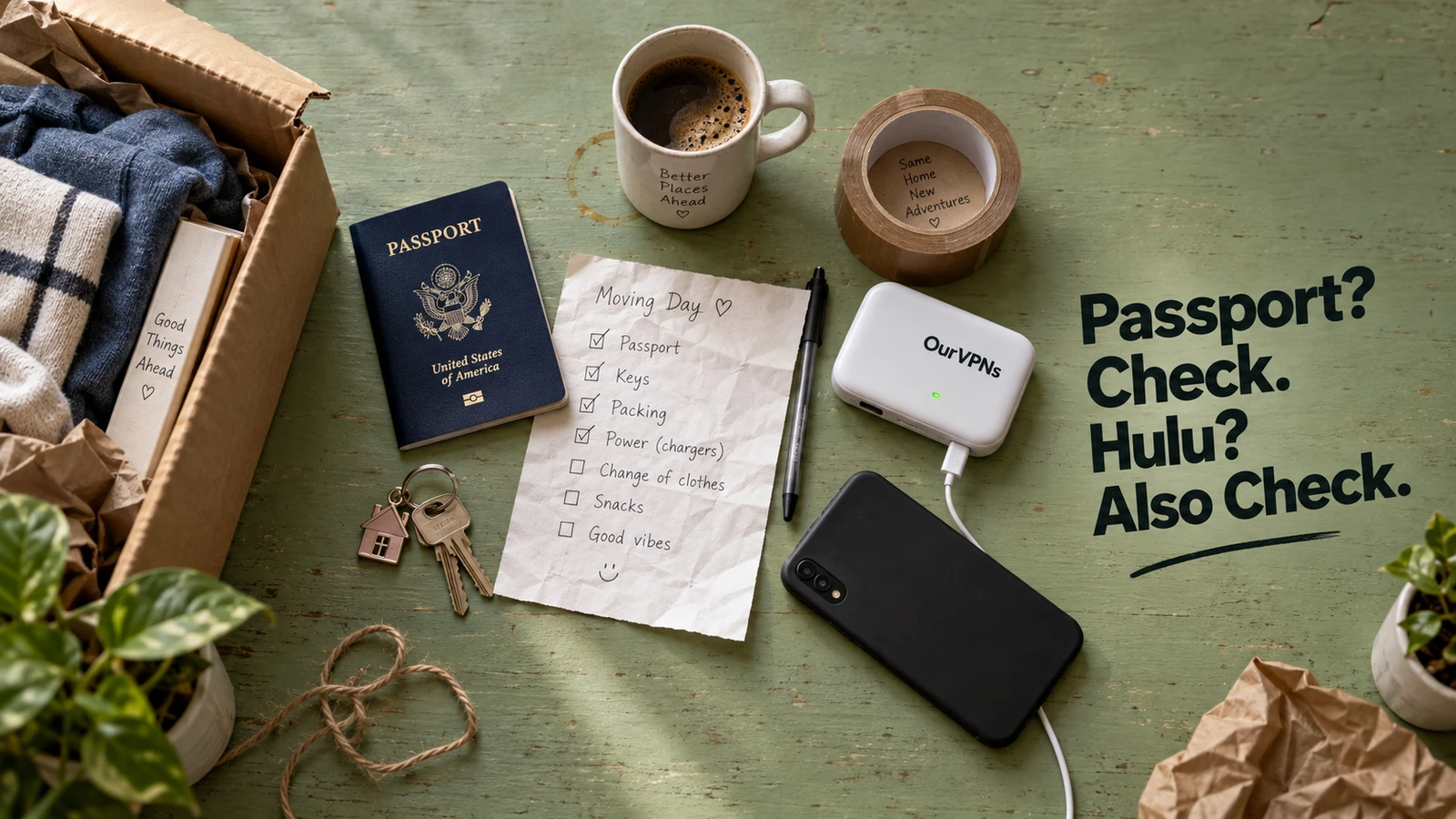
Put it on a small router. A travel router carries that US connection for every device in your new home, including smart TVs that can't run VPN apps. How a travel router home VPN works covers the setup. Set it up and test it at home before you pack it.
Keep your US streaming subscriptions on US billing. Existing subscriptions usually keep working more smoothly than signing up fresh from abroad. Our why streaming apps block VPNs post explains what actually gets detected.
Get written approval if you work remotely for a US company. Working from another country affects taxes, payroll and compliance on both sides, and it's much easier to sort out before you go than after an awkward email from HR.
Use a password manager and make sure you can log into it from a brand new device, because one day you'll need to.
Keep offline copies of your most important documents on your phone.
The last two weeks
Enroll in the State Department's Smart Traveler Enrollment Program (STEP) so the nearest US embassy can reach you in an emergency.
Confirm your first housing abroad, and ask about the internet speed in writing if you work remotely.
Carry your important documents, medications and your router in your carry-on, not in checked bags or a shipping container.
Cancel or pause US services you won't need: gym, utilities, local subscriptions.
Say your goodbyes. Then eat one last meal you know you won't find where you're going.
Your first month abroad
Get a local SIM for data and local calls. Keep your US number active on the side.
Plug in your router and check that your US apps see the same location they did at home.
Set up a backup internet option, like a phone hotspot, for outages.
Complete any local registration your visa requires, on time. Some countries give you only a few weeks after arrival.
Open a local bank account if your residency or daily life needs one, and remember it may count toward the FBAR threshold.
Update your addresses with anyone who still needs to know where you are.
Country guides for Americans
If you've picked a destination (or you're deciding), our country guides focus on keeping your US TV, banking and work logins working there:
Quick answers
What should I do first when moving abroad from the US? Check your passport's expiration date and figure out your visa or residency path. Everything else depends on those two.
Do I still pay US taxes if I live abroad? You still file. Whether you owe anything depends on your income and the tax breaks you qualify for, like the foreign earned income exclusion. A cross-border tax professional can tell you for sure.
Can I keep my US phone number when I move abroad? Yes. Keep your current plan or move to a cheaper plan that works abroad. Be careful with internet-only numbers, since many banks won't send verification codes to them.
Do I need a US address after moving abroad? In practice, yes. Banks, card companies and government agencies expect one. A trusted family member's address or a virtual mailbox service are the usual solutions.
What is a digital nomad visa? A temporary visa that lets you live in a country while working remotely for employers or clients elsewhere. They usually require proof of foreign income, health insurance and a clean background check, and requirements vary by country.
Will my US streaming and banking apps work after I move? Some will, some won't, and banking apps often start asking for extra verification when your logins come from a new country. A steady US residential connection on a router keeps them working the way they did at home.
The short version
Moving abroad goes smoothly when you do things in the right order: passport and visa first, then taxes and banking, then your phone number, mail and address, then your digital setup, then the fun part. Most checklists stop before that digital step, and it's the one that bites people in their first week, when the bank, the email and the TV all decide at once that you're a stranger.
Want your US apps to feel at home wherever you land? Start your free trial and set up your US connection before you pack the router.