Is Google Banned in China? Search, Gmail and Maps in 2026
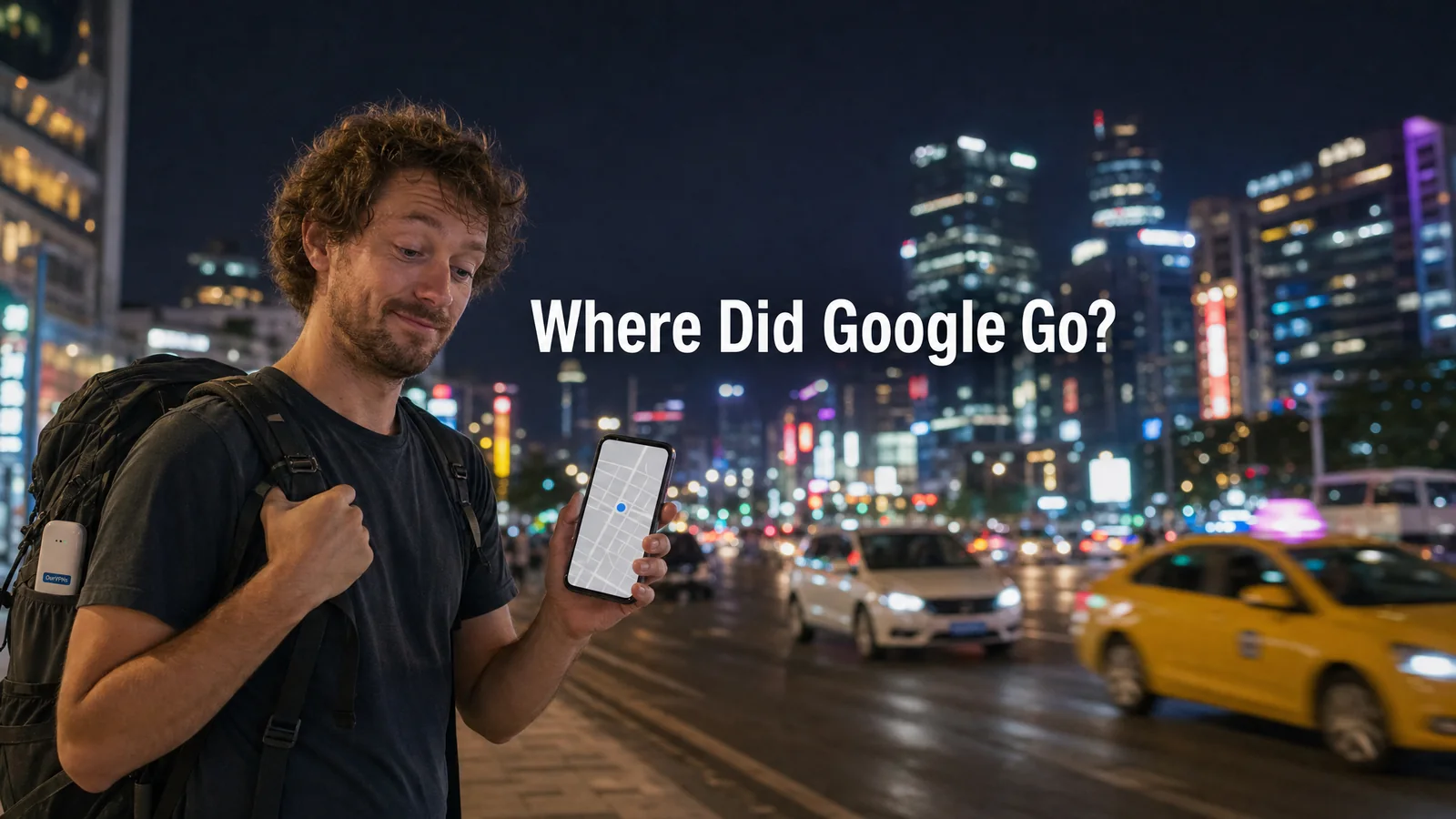
You land in Shanghai, the taxi line moves fast, and you pull out your phone to find the hotel. Google Maps shows a beige grid with a blue dot floating in it like a lost balloon. You open Gmail to find the booking email. Spinning wheel. You type "how to get to my hotel" into Google. "This site can't be reached." You stand there holding a phone that suddenly knows nothing, while the driver politely waits.
Nothing is broken. You just met the Great Firewall, and Google is one of its oldest and most famous victims. Here's what's blocked, why, what still works, and how travelers and expats keep their Google life going in 2026.
The quick answer
Yes, Google is blocked in mainland China. Search, Gmail, Maps, Drive, Docs, Calendar, Meet, Translate, YouTube, the Play Store and Gemini all fail on Chinese Wi-Fi and Chinese SIM cards.
It has been this way for years. Google moved its Chinese search to Hong Kong in 2010, and almost everything else was cut off in 2014.
Hong Kong and Macau are different. Google works there like it does at home.
You can still reach Google from the mainland if your data leaves China first: international roaming, a travel eSIM that routes through Hong Kong, or a VPN that can actually get past the firewall.
Set it all up before you fly. Once you land, the Play Store, VPN websites and most help pages are blocked too.
Why Google is banned in China
Short version: Google wouldn't keep censoring its search results, and China doesn't allow foreign services it can't control.
The longer version starts in 2006, when Google launched google.cn and agreed to filter results to follow Chinese law. That deal fell apart in 2010. After a cyberattack on Google and dozens of other companies, Google announced it would stop censoring, and on March 22, 2010 it began sending google.cn visitors to its uncensored Hong Kong site. China then filtered and slowed that site on the mainland.
For a few years some Google services hung on, slowly. In late May and early June 2014, just before the 25th anniversary of the Tiananmen Square crackdown, nearly all of them went dark. Gmail held on through third party mail apps until late December 2014, when that route was blocked as well. The last piece to go was Google Translate, which Google itself discontinued in mainland China in October 2022, citing "low usage."
Since YouTube belongs to Google, it went the same way. Our guide to whether YouTube is blocked in China covers that one in detail.
What's blocked, service by service
Google Search: blocked. Bing works on the mainland, but with China's filtering, so sensitive topics come back thin.
Gmail: blocked in the browser, the Gmail app and in Apple Mail or Outlook when they connect to a Gmail account. Expect a backlog of emails to arrive all at once the moment you reach Hong Kong or turn on roaming.
Google Maps: blocked or barely usable. Even when it loads through roaming, street maps in China are often outdated, and the satellite view and street lines can sit noticeably apart because of how map data is handled in China. Fun for a puzzle, terrible for finding a dumpling shop.
Drive, Docs, Sheets, Calendar and Meet: blocked. Shared work files and calendar invites stop syncing. For work video calls, see which meeting apps still work in China.
Google Translate: discontinued on the mainland since 2022, and blocked anyway.
Play Store: blocked. You can't install or update apps from it, and Android phones sold in China come without Google services at all.
Gemini and other Google AI: blocked, like most Western AI tools.
The sneaky ones: "Sign in with Google" buttons, some CAPTCHA boxes and websites that load Google code in the background can hang or half load. If a non Google site acts weird in China, that's often why.
The Chrome browser itself still runs on your laptop. It just can't reach Google's websites, and its built in translate and sync features stop working.
What people in China use instead
China has its own version of almost everything, and some are worth installing before you go:
Search: Baidu is the big one. Bing also works.
Maps: Amap (Gaode) and Baidu Maps are accurate and fast, though mostly in Chinese. Apple Maps works well in China on an iPhone, because Apple uses local map data there, with many English labels.
Translate: Apple's Translate app, Microsoft Translator, Baidu Translate or Youdao. Download offline Chinese language packs at home in case you're stuck without a signal.
Email: Outlook and iCloud Mail usually work, sometimes slowly. QQ Mail and 163 Mail are the local favorites.
Messaging and everything else: WeChat, which handles chat, payments, taxis and food delivery. If you'll miss WhatsApp most, here's what actually works for WhatsApp in China.
How travelers still use Google in China
Google is blocked inside the mainland network. So the trick is simple: make your data leave China before it reaches Google. There are three ways to do that.
1. International roaming on your US plan
When you roam, your phone connects to a Chinese tower, but your data travels back through your home carrier first. Google, Gmail and Maps load normally. The catch is price, speed caps after a daily limit, and coverage: it only works on your phone's mobile data, not hotel Wi-Fi or your laptop. Our roundup of the best international phone plans compares the options.
2. A travel eSIM that routes outside China
Many travel eSIMs work the same way, usually for much less money per gigabyte. Read the details before you buy: some China plans use local routing, which means Google stays blocked. Look for wording like "Hong Kong IP" or "works with Google," and install it at home. Same limit as roaming, though: phone only. One catch: a Hong Kong IP fixes Google but not ChatGPT, which OpenAI blocks there too, so read is ChatGPT available in China and Hong Kong if you need it on your trip.
3. A VPN that can get past the firewall
A VPN covers what roaming can't: hotel Wi-Fi, your work laptop, a tablet, and every device behind a travel router. The problem is that most VPNs don't last long in China. The firewall recognizes common protocols like WireGuard and OpenVPN and cuts them off, and big VPN brands' servers get blocked in bulk. We looked at what the big names say about themselves in does NordVPN or ExpressVPN work in China.
What holds up is a stealth protocol that makes your connection look like ordinary web browsing. OurVPNs Stealth mode uses VLESS + REALITY and Hysteria2, and we tested it working from inside mainland China as of October 2026. Our stealth VPN guide explains how it works without the jargon, and the full setup is in our VPN for China guide.
Is it legal to use Google in China?
Opening Gmail isn't the issue. Getting around the firewall is. China only allows government approved VPNs, mostly for companies. The US State Department's China travel advisory puts it bluntly: VPN use in China is illegal in most cases and may result in confiscation of your device, a fine or detention.
In practice, reported enforcement has mostly targeted people selling VPN access, and many foreigners quietly use VPNs for email, banking and calling family. "Mostly" isn't "never," though, so make the call with your eyes open. Roaming and routed eSIMs don't involve a VPN at all, which is one reason so many visitors rely on them for their phone. If you're moving to China for work, ask your employer what it provides. We're a VPN company, not lawyers. Our page on countries where VPNs are banned or restricted has the bigger picture.
Keep your Google account from locking you out
Here's a problem nobody mentions until it happens. You finally get Gmail to load from China, and Google says "We noticed a sign in from a new location" and asks you to verify by text. Your US SIM is in a drawer. Now you're locked out of your own email, in a country where you can't easily call Google either.
Do this before you fly:
Turn on a backup sign in method that doesn't need a text, like an authenticator app or Google's backup codes. Print the codes and keep them in your bag.
Keep your US number alive so codes can still reach you. Our guide on why your authenticator app shows the wrong location explains the security prompts you'll see.
Make your important stuff available offline: boarding passes, hotel bookings, Google Maps offline areas for any stopover outside the mainland, and key Docs.
Log in from one steady connection. Google gets suspicious when your account jumps from the US to China to a VPN server in Singapore to Hong Kong in two days. A steady connection looks like normal life. If Google keeps showing you its "unusual traffic" page, our post on why VPNs trigger Google CAPTCHAs explains why.
That last point is where a dedicated residential IP helps. OurVPNs connects you through a dedicated residential IP on real US home broadband, assigned to you alone and not shared, so Google, your bank and your work tools see the same US home connection every time instead of a datacenter address. For the banking side, read banking from China without getting locked out.
Your before you fly checklist
Update every Google app and sign in on each device you're bringing.
Set up backup codes or an authenticator for your Google account.
Install the China alternatives: Amap or Apple Maps, a translate app with offline Chinese, and WeChat.
Pick your route out: roaming, a routed eSIM, a stealth VPN, or a mix. A common combo is an eSIM for the phone and a VPN for hotel Wi-Fi and the laptop.
Install and test VPN apps at home. You can't download them after you land.
Staying for months? Our guide for Americans living in China covers payments, phones and visas.
Quick answers
Is Google still banned in China in 2026? Yes. Google left mainland China in 2010, and its services have been fully blocked there since 2014.
Why is Google banned in China? Google stopped censoring its search results in 2010, and China blocks foreign services that don't follow its censorship rules.
Does Gmail work in China? Not on Chinese Wi-Fi or a Chinese SIM, including in Apple Mail and Outlook. It works on international roaming, a routed eSIM, or a VPN that gets past the firewall.
Does Google Maps work in China? Mostly no, and even when it loads, maps there are often outdated or slightly misaligned. Apple Maps, Amap or Baidu Maps are better choices.
Does Google work in Hong Kong? Yes. Hong Kong and Macau are outside the Great Firewall.
What do Chinese people use instead of Google? Baidu for search, Amap or Baidu Maps for navigation, WeChat for messaging and payments, and QQ Mail or 163 Mail for email.
The short version
Google is blocked across mainland China, and has been for over a decade. Your phone can still reach it on roaming or a routed eSIM, and a stealth VPN covers hotel Wi-Fi and laptops. Set up backup sign in codes, download the local alternatives, and test everything at home before you fly, because the firewall won't let you fix it later.
Heading to China soon? Start your free trial