Best Travel Router for a VPN in 2026: 7 Picks
You check into the hotel and count the devices: two phones, two laptops, a tablet, the streaming stick you swore you'd use this time. The Wi-Fi login wants your room number and last name on every single one, and the VPN app on the work laptop isn't allowed to install anyway. By device number four you're questioning your life choices.
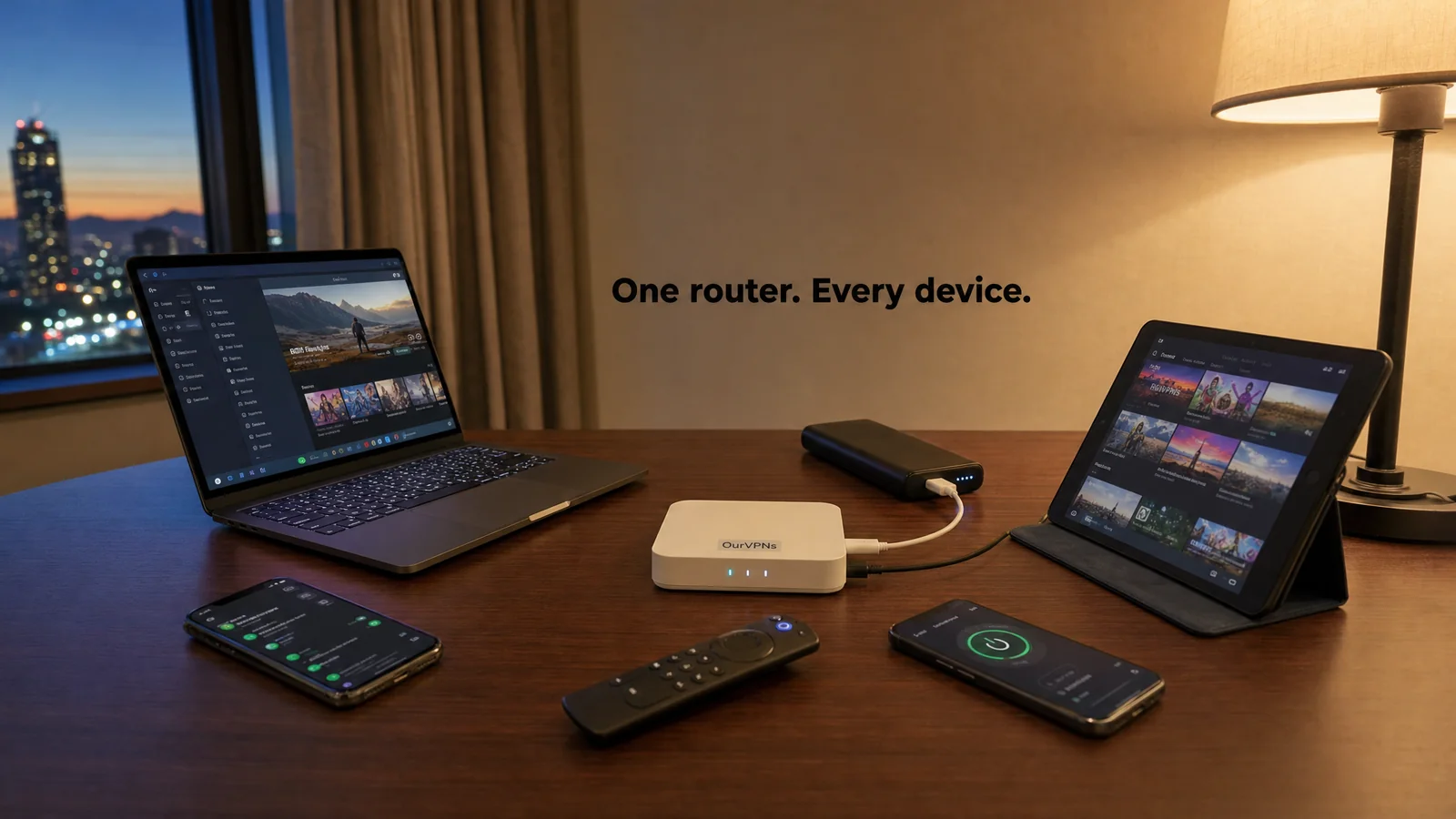
A travel router fixes all of that. It logs in to the hotel once, makes your own private Wi-Fi, and runs the VPN for everything behind it. The hard part is picking one, because the shelves are full of small boxes with big numbers on them. Here are the ones worth your money in 2026, and the one thing no router can do on its own.
The quick answer
Best for most travelers: GL.iNet Beryl AX (GL-MT3000). Fast enough for WireGuard, USB-C powered, under $100.
Best if you want speed headroom: GL.iNet Beryl 7 (GL-MT3600BE). Wi-Fi 7 and the fastest VPN numbers in this list.
Best premium pick: GL.iNet Slate 7 (GL-BE3600), with a touchscreen for quick changes.
Best on a budget: GL.iNet Slate Plus (GL-A1300), or the Opal (GL-SFT1200) if you only need light use.
Best if your home runs UniFi: the UniFi Travel Router.
And the part most roundups skip: the router only carries the tunnel. What websites see depends on where that tunnel comes out. A travel router connected to a regular datacenter VPN still looks like a datacenter VPN.
How we picked
We didn't build a lab and run a speed shootout, and we won't pretend we did. These picks come from each maker's own spec pages (checked in October 2026), the VPN speeds they publish for client mode, and the questions our customers actually ask us before a trip. The speed numbers below are the manufacturers' "up to" figures from local tests. Hotel Wi-Fi will usually be slower than all of them, so think of them as headroom, not a promise. Our breakdown of what really slows a VPN down when you travel explains why.
What actually matters in a VPN travel router
VPN client support. Look for WireGuard and OpenVPN built into the router's own menu. WireGuard is usually the faster of the two. Our OpenVPN vs WireGuard guide explains the difference.
Processor power. Encryption happens on the router's chip, so a weak chip caps your speed no matter how good the hotel internet is.
USB-C power. It means the router can run from a power bank or a phone charger instead of its own brick, as long as that charger delivers what the router asks for (5V/3A on most models here, USB-C PD on the Wi-Fi 7 ones). Weak ports, like the one on the hotel TV, can make it reboot under VPN load.
Repeater mode that copes with hotel login pages. Every router here can join Wi-Fi and share it, but you'll want to know the captive portal routine. Our hotel Wi-Fi login fix covers the order that works.
A kill switch. If the tunnel drops, the router should block traffic instead of quietly using the hotel's connection.
Room to grow. Routers that run OpenWrt (like GL.iNet's) can run extra software, which matters if you ever need a stealth protocol for a country that blocks VPNs.
1. GL.iNet Beryl AX (GL-MT3000): best for most people
This is the one we'd hand to a friend who just wants it to work. It's pocket sized, runs on USB-C at 5V/3A, has Wi-Fi 6 and a 2.5 Gbps WAN port for fast hotel or apartment Ethernet. GL.iNet's spec page lists up to 300 Mbps with WireGuard and up to 150 Mbps with OpenVPN in client mode, with a list price of $98.99.
Why it wins: plenty of speed for video calls and streaming on real world hotel internet, a friendly admin panel, and it's been around long enough that most setup questions already have answers. Watch out for: it's not the smallest, and it has one LAN port.
2. GL.iNet Beryl 7 (GL-MT3600BE): best for speed
The newer Beryl, launched by GL.iNet in February 2026 at $139.99, moves to Wi-Fi 7 and two 2.5 Gbps Ethernet ports. GL.iNet quotes up to 1,100 Mbps with WireGuard and up to 1,000 Mbps with OpenVPN DCO. It powers over USB-C with Power Delivery.
Why pick it: if you work from apartments with fast fiber, move big files, or just want the router to never be the bottleneck. Watch out for: you're paying for speed most hotel Wi-Fi will never deliver.
3. GL.iNet Slate 7 (GL-BE3600): best premium pick
The Slate 7 adds a small touchscreen, so you can flip the VPN on and off or check your connection without opening a laptop. It has Wi-Fi 7, 2.5 Gbps WAN and LAN ports, and USB-C Power Delivery. GL.iNet's page lists up to 490 Mbps with WireGuard and up to 385 Mbps with OpenVPN DCO, with a list price of $159.99 (GL.iNet's store often runs it lower).
Why pick it: the screen is handy when you're switching networks a lot, and it's a comfortable all rounder. Watch out for: at 295 grams it's on the heavier side, and the Beryl 7 posts faster VPN numbers for less money.
4. GL.iNet Slate Plus (GL-A1300): best budget all rounder
Older Wi-Fi 5 hardware, but a solid little workhorse. It has two LAN ports, USB-C power and a USB 3.0 port. GL.iNet lists up to 170 Mbps with WireGuard but only up to 28 Mbps with OpenVPN, with a list price of $69.99.
Why pick it: fine for one or two people on WireGuard. Watch out for: skip it if you need OpenVPN.
5. GL.iNet Opal (GL-SFT1200): cheapest that still makes sense
GL.iNet lists it at $39.99, which makes it one of the cheapest GL.iNet travel routers and the cheapest dual band pick here. Dual band Wi-Fi 5, two LAN ports, USB-C power. The catch is speed: GL.iNet's figures are a maximum of 65 Mbps with WireGuard and 12 Mbps with OpenVPN.
Why pick it: a backup router, a solo traveler on WireGuard, or a first experiment. Watch out for: it's not the one for a family of streamers, and it's more limited for heavier stealth use.
6. UniFi Travel Router: best if your home runs UniFi
Ubiquiti's slim travel router is built to extend a UniFi home network wherever you are. The UniFi store page lists it at $79, says WireGuard is supported, and says it works in stand alone mode without a UniFi account. Ubiquiti's tech specs show Wi-Fi 5, two gigabit Ethernet ports and USB-C power at 5V/2A, in a body that weighs just 89 grams, the lightest in this list.
Why pick it: if your house already runs UniFi, it slots right in. Watch out for: Wi-Fi 5 and gigabit ports trail the newer GL.iNet models, and its extra tricks are most useful if you live in the UniFi world. No UniFi gear at home? Our UniFi Travel Router setup guide shows how to run it standalone with a residential VPN.
7. TP-Link TL-WR1502X: a familiar alternative
TP-Link's travel routers are easy to find in electronics stores, which is handy when you forgot yours at home. Their own setup guide (updated June 2026) uses the TL-WR1502X as its example and shows the VPN client supporting OpenVPN, PPTP, L2TP/IPSec and WireGuard. Stick with WireGuard or OpenVPN; PPTP is old and not secure.
Why pick it: availability and a simple app. Watch out for: fewer options for adding extra software than GL.iNet's OpenWrt based routers.
The thing no travel router can do by itself
A travel router is a very good delivery truck. It doesn't decide the address on the package. That comes from the VPN it connects to.
Put a regular VPN service on it and every device behind the router gets a shared datacenter IP, which streaming apps, banks and some work systems recognize right away. Put a residential connection on it and every device gets an IP from real US home broadband instead. It's a setup many remote workers and long term travelers use to keep logins calm. We explain the whole path in how a travel router with a home connection works, and our VPN router vs VPN app comparison helps if you're still deciding whether you need a router at all.
OurVPNs works on travel routers with WireGuard or OpenVPN, and you get a dedicated residential IP on real US home broadband, assigned to you and not shared with anyone else. Setting one up yourself? Our step by step guide to a VPN on your router walks through it. Rather skip the setup? A preconfigured VPN router with your own US home IP arrives ready to plug in, and you can see all six kits in our router store.
Setting it up in five steps
Set it up at home first. Update the firmware, add your VPN profile and turn on the kill switch before you pack. Package downloads and support chats are easier on your home internet.
Power it from USB-C in the hotel, from its adapter or a power bank that can deliver enough power.
Connect it to the internet. Ethernet if the room has a port, otherwise join the hotel Wi-Fi in repeater mode.
Get past the login page with the VPN off, then switch the VPN on.
Check your IP from one device. Our guide to testing whether your travel router uses the expected IP takes two minutes.
Traveling to a country that blocks VPNs?
The standard VPN menu on most travel routers only offers WireGuard and OpenVPN, and those are exactly what firewalls in places like China look for. Stealth protocols like VLESS + REALITY and Hysteria2 are disguised to look like ordinary web traffic. OurVPNs Stealth mode uses both, and it was tested working from inside mainland China as of October 2026.
Running stealth protocols on a router takes more processing power and some extra setup, which is why the faster models above are the better fit. Our guide to a stealth VPN on a GL.iNet travel router covers which models suit it and how it works. And the honest note: VPN rules differ by country, so check the rules where you're going. We're a VPN company, not lawyers.
Bringing a work laptop?
This is where a travel router shines. The work laptop just joins Wi-Fi, no extra app needed. Two things to keep in mind: the router doesn't switch off your company's security tools, and your employer's policies still apply. If your company has its own VPN too, our guide to using a travel router with a corporate VPN explains how they stack.
Quick answers
Do I need a VPN for a travel router? No, a travel router works without one, and it already helps with hotel logins and device limits. The VPN is what encrypts your traffic and decides which IP websites see.
What's the best portable VPN router for travel? For most people, the GL.iNet Beryl AX. Go Beryl 7 for more speed, Slate 7 for the touchscreen, Opal or Slate Plus to save money.
Is it worth putting a VPN on a router? If you travel with more than one device, use a work laptop that can't install apps, or want your TV covered, yes. For one phone, an app is simpler.
Will a travel router make my streaming apps work abroad? It helps most when the VPN behind it comes out on a residential connection. A datacenter VPN on a router looks the same to a streaming app as a datacenter VPN app. Use your own subscriptions and check each service's terms.
Can a travel router use phone data? Most can tether to a phone over USB, and some models take a SIM card. Handy when the hotel Wi-Fi gives up.
The short version
For most travelers, the GL.iNet Beryl AX is the sweet spot. The Beryl 7 is the speed pick, the Slate 7 the premium one, and the Slate Plus or Opal the budget ones. Whichever you choose, the router only carries the tunnel. Pair it with a dedicated residential US IP and every device behind it, from the work laptop to the TV, comes out on a US home connection.
OurVPNs runs on your travel router with WireGuard, OpenVPN or Stealth mode, from $35 a month or $350 a year, with 24/7 support by email, phone and Telegram. Try it for 3 days first. Start your free trial