Americans Living in Japan: Keep US Accounts Working
Japan has a way of ruining other countries for you. The train that says 9:02 leaves at 9:02. The convenience store sells a better lunch than most American restaurants. There's a vending machine on a mountain trail, and it's spotless. You came for two weeks, and now you're googling apartment layouts like 1LDK and learning which garbage goes out on Thursdays.
Then the US internet notices. Hulu says it isn't available in your region. Your bank wants a code texted to a number you haven't checked in a month. Your brokerage app asks you to verify your identity, again. None of this means you did anything wrong. Your American accounts still expect an American login, and they get twitchy when one shows up from Tokyo.
Here's how Americans living in Japan keep US accounts working, plus the visa, tax and everyday basics worth knowing before you sign a lease.
The quick answer
Japan's internet is fast and open. Freedom House rates Japan "Free" and found no blocked websites or social media.
Global apps work, with Japanese catalogs. Netflix, Prime Video, YouTube and Google all load normally, but streaming libraries are the Japan versions.
US only services stop. Hulu, YouTube TV, Peacock and the network apps expect a US home connection. Japan even has its own Hulu, a separate Japanese service, and your US login doesn't carry over.
US banks, brokerages and work tools get nervous when logins suddenly come from Japanese IPs.
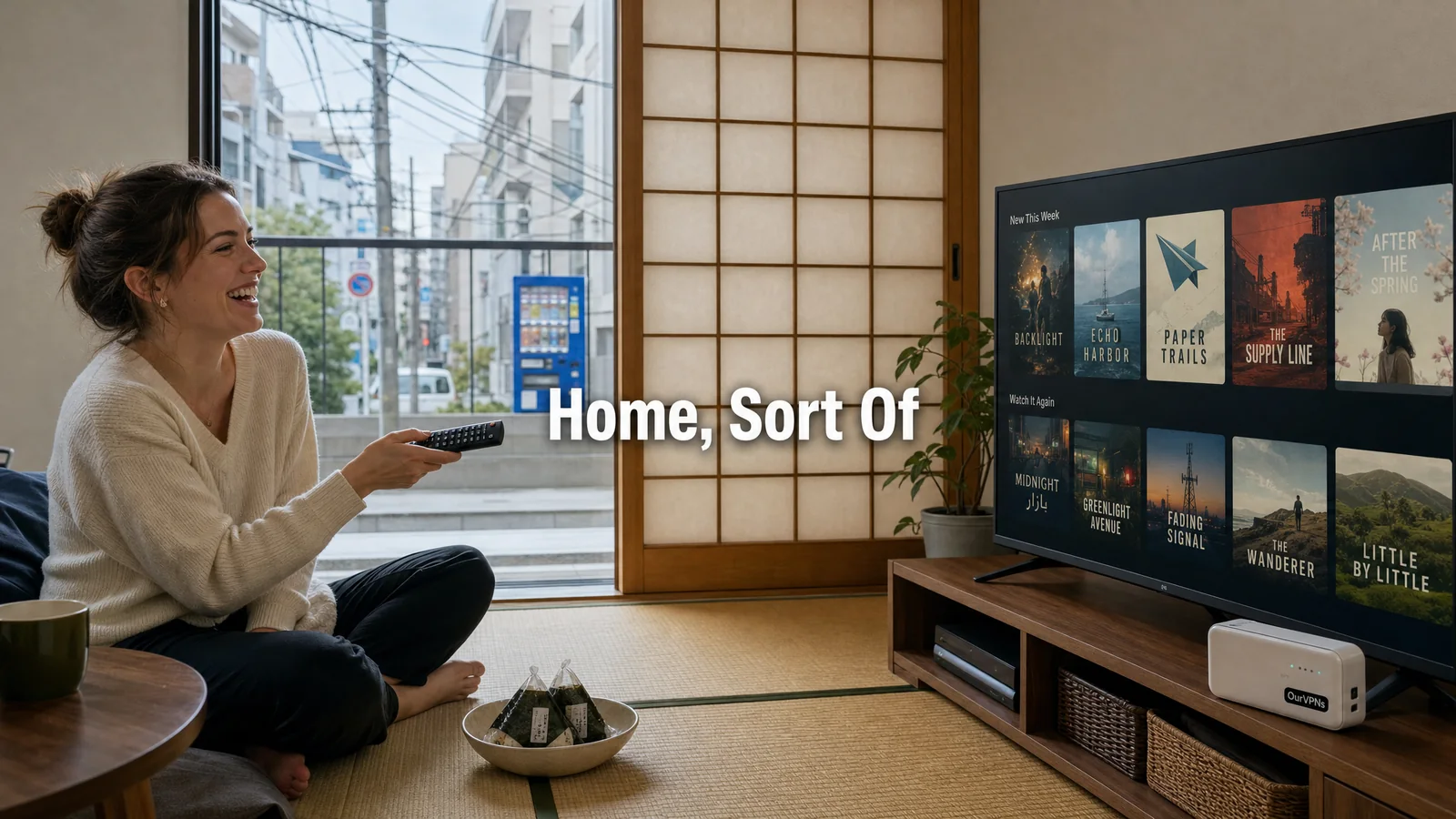
The fix is one steady US home connection, ideally on a small router in your apartment, so every device logs in from the same American living room.
How many Americans live in Japan?
More than you might think. Japan's Immigration Services Agency counted about 66,000 US citizens registered as residents at the end of 2024, as summarized on Wikipedia's Americans in Japan page. That number leaves out US military personnel, so the real American community is a lot bigger, especially around the bases in Okinawa.
It's a big community inside a much bigger one: Japan passed 4 million foreign residents for the first time at the end of 2025, Nippon.com reported. Translation: you won't be the only American at the ward office, and someone in a Facebook group has already asked your exact question about health insurance.
First, the visa reality in 2026
Americans can visit Japan without a visa for up to 90 days. The US is on the Ministry of Foreign Affairs visa exemption list. According to the Embassy of Japan, that stay is for things like sightseeing, conferences and visiting friends, and paid activities in Japan need a visa, so it's great for a scouting trip and not a way to live there.
For actually living in Japan, Americans usually go one of these routes:
A work visa through a Japanese employer, which is how most American residents do it.
A spouse or family visa if you're married to a Japanese citizen or resident.
The digital nomad visa for remote workers. It allows up to six months, needs an annual income of at least 10 million yen plus health insurance with at least 10 million yen of medical coverage, and Japan's Ministry of Foreign Affairs says it can't be extended. Here's who qualifies for Japan's digital nomad visa and how to apply. Our 2026 guide to Asia's digital nomad visas compares it with Thailand, Malaysia, South Korea and the rest.
Student visas, including language schools.
If you stay long term on a work, family or student visa, you'll get a residence card, and you'll need it for almost everything: your apartment, a Japanese bank account, a phone contract. Rules change, so confirm the details with the Japanese embassy or consulate before you book. We're a VPN company, not immigration lawyers.
What works in Japan as is (and what doesn't)
Good news first. Japan is one of the easiest countries in Asia to be online. Freedom House's 2025 report scores Japan 78 out of 100, rated "Free," and lists no blocked websites, no blocked social media and no restricted networks. Japan has no law against using a VPN, though we're a VPN company, not lawyers. Still, a few things will feel different:
Streaming works, with a Japanese library. Netflix and Prime Video open fine but show what's licensed in Japan, and some menus default to Japanese. Our guide to changing your Netflix region as an American abroad explains why your shows disappeared.
US Hulu is US only. Hulu's help center says it only works in the US. The Hulu you see on Japanese TVs is Hulu Japan, a separate service that Nippon TV took over in 2014.
Live US TV checks where you are. YouTube TV, Peacock and the network apps all look for a US home connection. If YouTube TV keeps asking you to verify your location, here's our YouTube TV location fix.
Baseball is the plot twist. Japan cares a lot about MLB thanks to its stars in the US, so many big games are easy to find on Japanese TV, but often with Japanese commentary at breakfast time. Our guide to watching the World Series from abroad covers your US options.
Japan also has strict copyright rules, and a VPN doesn't change them. Use your own subscriptions and follow each service's terms.
Why a regular VPN app keeps letting expats down
The usual advice is "get a VPN and pick a US server." It works for about a week. Then Hulu shows a proxy error, your bank asks for a selfie, and your work laptop flags a risky sign in.
Most VPNs run from data centers, and streaming apps, banks and security tools keep lists of data center addresses. A website can tell a server rack from a living room. We explain how in why streaming apps block VPNs.
OurVPNs gives you a dedicated residential IP on real US home broadband, assigned to you alone and not shared with anyone. Your apps see a normal US home internet connection, and because it's yours, it stays the same day after day. Banks and work tools love boring and consistent.
Set it up once: put it on a router in your apartment
Smart TVs and streaming sticks usually can't run a VPN app well. A small travel router covers every screen at once, and it works with your apartment's fiber or the building Wi-Fi.
Sign up and pick your US location. You get a WireGuard or OpenVPN setup.
Load it on a travel router. Here's how a travel router with a home VPN works.
Plug it into your apartment's internet or connect it to the building Wi-Fi.
Connect your TV, laptop and phone to the router's Wi-Fi and sign in to your US accounts like normal.
A Japan detail: Japan runs on 100 volts, at 50 Hz in the east and 60 Hz in the west, including Osaka and Kyoto. Most router adapters handle 100 to 240 volts and the flat two pin plugs look familiar, but check the label, and bring an adapter for anything with a third, round ground pin.
Heading out to Kyoto, Hokkaido or a ryokan with a login page on the Wi-Fi? Bring the router. Our guide to getting a travel router past hotel Wi-Fi login pages has the fix.
Banking, brokerages and payment apps: consistency wins
Your US bank's fraud system isn't upset that you moved to Japan. It's reacting to a login pattern that jumped across the Pacific and keeps switching between apartment fiber, a Japanese SIM and café Wi-Fi. That looks a lot like someone stealing your account.
Logging in from one steady US residential IP keeps that pattern calm. Our guide on why your US bank keeps blocking you abroad goes deeper, including what an IP can't fix. Investment and crypto apps are often stricter than banks, and we cover them in Coinbase, Kraken and Robinhood logins abroad. For sending money to friends back home, see Venmo, Zelle and Cash App abroad.
Keep your US phone number alive, too, so verification texts keep arriving. Our roundup of the best international phone plans compares cheap ways to do it.
Working remotely for a US company from Japan
First, make sure your employer knows and approves, and that your visa allows the work. Remote work has real tax, payroll and security consequences, and a tourist stay isn't meant for it.
Once that's settled, a steady US home connection keeps your work logins, company VPN and multi factor prompts consistent instead of tripping a review every time you move from home to a coworking space. If your authenticator app keeps showing Tokyo, our guide on why your authenticator app shows the wrong location explains what's going on. Our guide to working remotely abroad covers the rest.
Little Japan things nobody warns you about
The time difference is brutal. Japan doesn't use daylight saving time and sits 14 hours ahead of US Eastern time in winter and 13 in summer. Your Monday morning standup is Monday night in Tokyo.
Taxes follow you. US citizens file US taxes wherever they live; start with the IRS page for US citizens abroad. Japan has its own twist: for your first five years of residence out of ten, you're a "non-permanent resident" and taxed on Japanese income plus foreign income paid in or sent to Japan, according to Japan's National Tax Agency. Talk to a cross border tax pro.
Pick one US location and stick with it. Bouncing between locations looks odd to every app. One steady home base looks normal.
Keep your US billing. Existing US subscriptions run smoother than signing up fresh from abroad.
Do the paperwork in order. Our moving abroad checklist for Americans covers mail, phone, banking and voting before you go.
Quick answers
How many Americans live in Japan? About 66,000 US citizens were registered residents at the end of 2024, according to Japan's immigration figures. US military personnel aren't included in that count.
Is using a VPN legal in Japan? Yes. Japan doesn't block websites or VPNs. Anything illegal in Japan, like downloading pirated video, stays illegal with a VPN.
How long can Americans stay in Japan without a visa? Up to 90 days, for short visits like tourism and business meetings, not paid work.
Can I watch US Hulu or YouTube TV in Japan? Both are US only and check your location. A dedicated US residential IP on your router gives them a US home connection to check. Use your own subscriptions and follow each service's terms.
Does my US bank work from Japan? Usually, but expect more security checks from a Japanese IP. A steady US residential IP keeps your logins looking like home.
The short version
Japan gives you trains that run on time, great food on every corner and an internet with nothing blocked. It won't give you US Hulu, a calm banking app or a work login that stops asking questions. Sort your visa first, keep your US phone number, and run one US home connection on a router in your apartment for the rest.
Ready to make your Tokyo apartment feel a little more like home? Start your free trial